Monday, January 9, 2017
why declare a pointer of type char instead of a variable in C++?
char *variable = "Some string here";
Is it declaring a pointer to type char instead of variable of type char, because the char datatype in C has a size of one byte, and more memory needs to be allocated than a char variable allows? The pointer is actually to an array of type char?
http://stackoverflow.com/questions/4826481/c-char-vs-string

Sunday, January 8, 2017
Main function in C++ -- or at least what works
/* A C listing with something odd - */
/* using a square() function twice */
#include <stdio.h>
#include <stdlib.h>
int main (void) {
return 0;
}
I was studying OOP with polymorphism, inheritance, and encapsulation. For some reason I picked up a book on C with C++. It's fun comparing to my memory of Daniel Shiffman's OOP and PHP's OOP.
Also, this is what happens if you compile a C++ program as a C program.
gcc square.c -o square-c.o
square.c:25:6: error: conflicting types for ‘square’
void square( int topleftX, int topleftY, int bottomleftX, int bottomleftY)
^ square.c:7:6: note: previous definition of ‘square’ was here
void square( int topleftX, int topleftY, long width)
^ square.c: In function ‘main’:
square.c:54:4: error: too few arguments to function ‘square’
square( pt_x3, pt_y3, side);
^ square.c:25:6: note: declared here
void square( int topleftX, int topleftY, int bottomleftX, int bottomleftY)
^ With polymorphism in C++ I can have multiple declarations of a function and the program figures out which one to use. Whereas with C, I cannot. This example illustrates function or method overloading.
See: https://en.wikipedia.org/wiki/Function_overloading
/* using a square() function twice */
#include <stdio.h>
#include <stdlib.h>
int main (void) {
return 0;
}
I was studying OOP with polymorphism, inheritance, and encapsulation. For some reason I picked up a book on C with C++. It's fun comparing to my memory of Daniel Shiffman's OOP and PHP's OOP.
Also, this is what happens if you compile a C++ program as a C program.
gcc square.c -o square-c.o
square.c:25:6: error: conflicting types for ‘square’
void square( int topleftX, int topleftY, int bottomleftX, int bottomleftY)
^ square.c:7:6: note: previous definition of ‘square’ was here
void square( int topleftX, int topleftY, long width)
^ square.c: In function ‘main’:
square.c:54:4: error: too few arguments to function ‘square’
square( pt_x3, pt_y3, side);
^ square.c:25:6: note: declared here
void square( int topleftX, int topleftY, int bottomleftX, int bottomleftY)
^ With polymorphism in C++ I can have multiple declarations of a function and the program figures out which one to use. Whereas with C, I cannot. This example illustrates function or method overloading.
See: https://en.wikipedia.org/wiki/Function_overloading
Saturday, January 7, 2017
Discovery compiling a C++ program from a 2003 book
In listing B3.1 on page 666 of "Sam's Teaching Yourself C in 24 hours", Change
#include <iostream.h> to #include <iostream>
Add the line
using namespace std;
See: http://stackoverflow.com/questions/13103108/why-cant-g-find-iostream-h
compile using
g++ endtime.cpp -o endtime.o
or
g++ endtime.cpp
Using gcc instead of g++ you have: endtime.cpp: In function ‘int main(int, char**)’: endtime.cpp:24:3: error: expected ‘;’ before ‘end_time’ end_time.minutes = 11; ^ endtime.cpp: In function ‘void print_time(time)’: endtime.cpp:39:48: error: expected ‘;’ before ‘tm’ cout << tm.hours << ":" << tm.minutes << ":" tm.seconds; See: http://stackoverflow.com/questions/28236870/undefined-reference-to-stdcout
This post also took advantage of escape sequences for the less than and greater than symbols. http://www.theukwebdesigncompany.com/articles/entity-escape-characters.php
#include <iostream.h> to #include <iostream>
Add the line
using namespace std;
See: http://stackoverflow.com/questions/13103108/why-cant-g-find-iostream-h
compile using
g++ endtime.cpp -o endtime.o
or
g++ endtime.cpp
Using gcc instead of g++ you have: endtime.cpp: In function ‘int main(int, char**)’: endtime.cpp:24:3: error: expected ‘;’ before ‘end_time’ end_time.minutes = 11; ^ endtime.cpp: In function ‘void print_time(time)’: endtime.cpp:39:48: error: expected ‘;’ before ‘tm’ cout << tm.hours << ":" << tm.minutes << ":" tm.seconds; See: http://stackoverflow.com/questions/28236870/undefined-reference-to-stdcout
This post also took advantage of escape sequences for the less than and greater than symbols. http://www.theukwebdesigncompany.com/articles/entity-escape-characters.php
Semantic Web Courses / Resources
Indiana.edu Semantic Course:
http://info.slis.indiana.edu/~
University of Edinbergh Semantic Web Systems book
https://www.inf.ed.ac.uk/
University of Georgia Semantic Web Course
http://lsdis.cs.uga.edu/
FAU Semantic Web Course
http://semanticweb.fau.edu/
Lehigh University Semantic Web Course
http://www.cse.lehigh.edu/~
UNB Semantic Web Techniques Course
https://www.cs.unb.ca/~boley/
Université Jean-Monnet Semantic Web Course
http://www.emse.fr/~
Linked Data Tools.com Semantic Web Basics
http://www.linkeddatatools.
University of Mannheim Semantic Web Technologies Course
http://dws.informatik.uni-
Finland Semantic Web and Ontology Engineering Course
http://www.cs.jyu.fi/ai/vagan/
TDT-44 Semantic Web Course
https://www.ntnu.no/wiki/
University of Rome -Knowledge Representation and Semantic Technologies
http://www.dis.uniroma1.it/~
University of Koblenz Semantic Web Course
https://west.uni-koblenz.de/
Euclid Project
http://euclid-project.eu/
Dr. Harald Sack, Linked Data Engineering - OpenHPI
https://open.hpi.de/courses/semanticweb2016
Linked Data Book - Tom Heath, Christian Bizer
http://linkeddatabook.com/editions/1.0/
What is Linked Data? - Manu Sporny
https://www.youtube.com/watch?v=4x_xzT5eF5Q&t=108s
http://info.slis.indiana.edu/~
University of Edinbergh Semantic Web Systems book
https://www.inf.ed.ac.uk/
University of Georgia Semantic Web Course
http://lsdis.cs.uga.edu/
FAU Semantic Web Course
http://semanticweb.fau.edu/
Lehigh University Semantic Web Course
http://www.cse.lehigh.edu/~
UNB Semantic Web Techniques Course
https://www.cs.unb.ca/~boley/
Université Jean-Monnet Semantic Web Course
http://www.emse.fr/~
Linked Data Tools.com Semantic Web Basics
http://www.linkeddatatools.
University of Mannheim Semantic Web Technologies Course
http://dws.informatik.uni-
Finland Semantic Web and Ontology Engineering Course
http://www.cs.jyu.fi/ai/vagan/
TDT-44 Semantic Web Course
https://www.ntnu.no/wiki/
University of Rome -Knowledge Representation and Semantic Technologies
http://www.dis.uniroma1.it/~
University of Koblenz Semantic Web Course
https://west.uni-koblenz.de/
Euclid Project
http://euclid-project.eu/
Dr. Harald Sack, Linked Data Engineering - OpenHPI
https://open.hpi.de/courses/semanticweb2016
Linked Data Book - Tom Heath, Christian Bizer
http://linkeddatabook.com/editions/1.0/
What is Linked Data? - Manu Sporny
https://www.youtube.com/watch?v=4x_xzT5eF5Q&t=108s
Friday, January 6, 2017
Understanding Python
I wanted to understand how to build a search engine. Daniel Shiffman implements his TFIDF index in JavaScript. Arden Dertat implements his search engine with TFIDF in Python.
I want to implement everything in JavaScript. To use Arden's code, it might be useful to learn Python. I found "How to Learn Python in Five Minutes - Daniel Moniz" on YouTube. (https://www.youtube.com/watch?v=ohr6O78jGzs) .
His code gives me the idea to try to implement the waypaver scraping script in python https://github.com/bshambaugh/waypaver-lsi/blob/master/scraper-four.php . I don't need it in Python, but such an exercise would teach me a bit about python in addition to making refactoring the PHP script to a more OOP scheme more interesting. Python is all about objects. Everything in Python is an object. If I wanted to go further, he mentioned coderbyte (https://coderbyte.com/) which offers some challenges as well as asking and answering questions on stackoverflow.
Resolving the programmers page at python.org (https://wiki.python.org/moin/BeginnersGuide/Programmers) leads me to a resource at (http://www.afterhoursprogramming.com/tutorial/Python/Overview/). I even found a tutorial about a web crawler if I want it (https://code.tutsplus.com/courses/crawl-the-web-with-python).
Looking at my scraper tells me I need to retrieve web pages. The Requests gives me some idea: http://docs.python-requests.org/en/master/ . If I believe the good words about it, it may be a good idea.
Doing this would also lead me to understand the code in SWAP (if I care to understand it). http://www.w3.org/2000/10/swap.doc
I want to implement everything in JavaScript. To use Arden's code, it might be useful to learn Python. I found "How to Learn Python in Five Minutes - Daniel Moniz" on YouTube. (https://www.youtube.com/watch?v=ohr6O78jGzs) .
His code gives me the idea to try to implement the waypaver scraping script in python https://github.com/bshambaugh/waypaver-lsi/blob/master/scraper-four.php . I don't need it in Python, but such an exercise would teach me a bit about python in addition to making refactoring the PHP script to a more OOP scheme more interesting. Python is all about objects. Everything in Python is an object. If I wanted to go further, he mentioned coderbyte (https://coderbyte.com/) which offers some challenges as well as asking and answering questions on stackoverflow.
Resolving the programmers page at python.org (https://wiki.python.org/moin/BeginnersGuide/Programmers) leads me to a resource at (http://www.afterhoursprogramming.com/tutorial/Python/Overview/). I even found a tutorial about a web crawler if I want it (https://code.tutsplus.com/courses/crawl-the-web-with-python).
Looking at my scraper tells me I need to retrieve web pages. The Requests gives me some idea: http://docs.python-requests.org/en/master/ . If I believe the good words about it, it may be a good idea.
Doing this would also lead me to understand the code in SWAP (if I care to understand it). http://www.w3.org/2000/10/swap.doc
Throwing Clay at a Wall

I'm trying to figure out how to do a natural language query (nlq) that uses the hierarchical and relational structure found in an ontology to return documents that are semantically related to the query, nlq triples which are instances of the ontologies used, and a graph of these instances in addition to related triples by SPARQL that use the subject or object of the nlq triples as the subject. Below is a query result of results from the query "Car Projects with Brent Shambaugh".
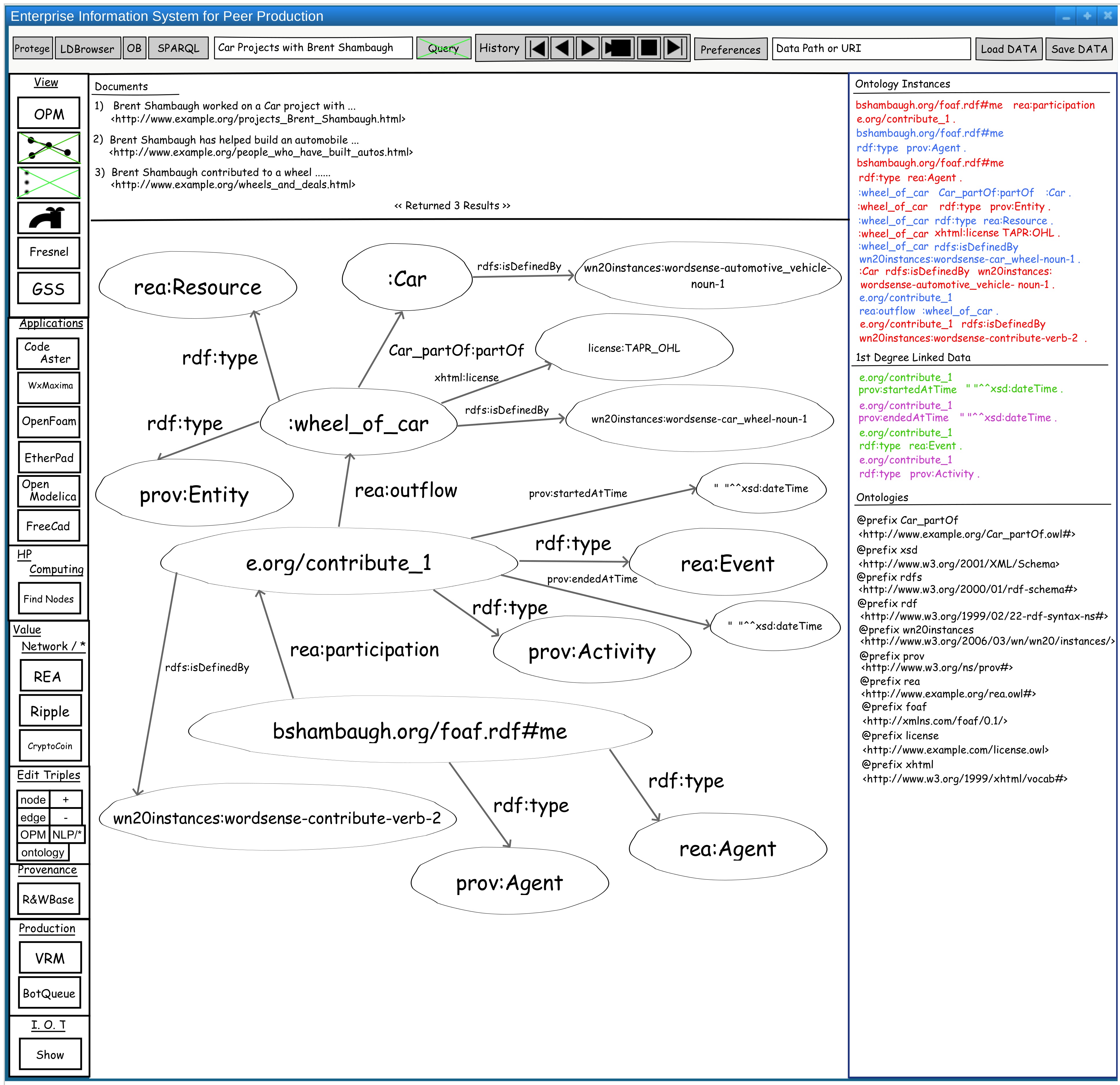
What I really want most is something like: this query contains terms that are described by these ontologies, and the terms are described by these triples.
I think I might be able to back this out of the query in this Sanchez's work, even though its aim was to get documents.
At the moment, I know typical search uses TFIDF. I know this from taking a Big Data (or at least starting) course in 2013. I also found a book called Mining Massive DataSets that contains a lot of the information from the course (http://infolab.stanford.edu/~ullman/mmds/book.pdf). Understanding it makes sense. Up to this point, I've struggled implementing it, resorting to things like Lucene and Solr coupled with Stanbol for nlp (this works for tagging). Fortunately, within the past few weeks I discovered Daniel Shiffman's coding rainbow videos. He explains how to do TFIDF (Coding Challenge $40.3: TF-IDF) https://www.youtube.com/watch?v=RPMYV-eb6lI .
I explored how to implement a search engine and I came across some blog posts by Arden Dertat :
How to Implement a Search Engine Part 1: Create Index
How to Implement a Search Engine Part 2: Query Index
How to Implement a Search Engine Part 3: Ranking tf-idf
He gives some links to his code.
Mr. Dertat also references a book on Information Retrieval: (http://nlp.stanford.edu/IR-book/information-retrieval-book.html)
Monday, January 2, 2017
Latest Photogate Pictures


Calibrated by dropping an object, and comparing to calculations from the kinematic equation. The distance between the two sensors is 1.13 m.
Subscribe to:
Posts (Atom)